Category: Headlines

  • What the End of REX vs. Zillow/NAR Means for You

    What the End of REX vs. Zillow/NAR Means for You

    The Supreme Court of the United States has declined to hear an appeal from Real Estate Exchange Inc. (REX) in its antitrust suit against Zillow Group, Inc. (Zillow) and the National Association of REALTORS® (NAR).

    The case had argued that NAR’s so-called “no-commingling” rule (which required MLS listings and non-MLS listings to be shown separately) unfairly disadvantaged non-MLS brokerages like REX and restricted competition on Zillow’s platform. Because the Supreme Court didn’t take the case, the lower court rulings in favor of Zillow and NAR now stand as the final word.

    Background

    • REX filed the lawsuit in 2021 against Zillow and NAR, challenging NAR’s “optional” no-commingling rule. Under that rule, some MLSs required listings from non-MLS sources to be displayed separately or in a less prominent way.

    • Zillow, having joined certain MLSs to access IDX feeds and support its listings inventory, changed its website display so that default listing results showed the MLS-affiliated listings, and non-MLS listings (like REX’s) were moved to a secondary “Other Listings” tab. REX claimed this caused a drastic drop in traffic to its listings.

    • The district court dismissed the antitrust claims, the United States Court of Appeals for the Ninth Circuit upheld that ruling, and finally the Supreme Court declined review on October 20, 2025.

    • Meanwhile, NAR repealed the optional no-commingling rule in June 2025, though its prior existence and effect remain central to this dispute.

    What It Means for Real Estate Sales Professionals

    Here are several practical take-aways for real estate professionals:

    1. Listing exposure & platform display still matter
      While the specific rule challenged in this case is gone, the decision reinforces that how listings are displayed on major sites like Zillow can have big impact. If you’re an agent working with non-traditional listing channels, keep in mind: traffic and visibility matter.

    2. Competition remains open, but legacy rules carry weight
      The ruling signals that optional industry rules (even those from large associations like NAR) may not automatically run afoul of antitrust laws if lower courts find they were truly optional and not enforced as mandatory. That means new business models (discount brokerages, hybrid models) still have room, but must carefully design how they interact with MLSs, platforms and associations.

    3. Protect your client’s interests by understanding platforms
      For a typical sales pro: make sure you understand how clients’ listings will appear on major portals. If you work outside MLS-dominated systems, know how listings compare in visibility. You may need to highlight to clients the difference in exposure or adjust marketing to compensate.

    4. Associations & regulation aren’t static
      The no-commingling rule may be repealed, but the broader questions of how MLS rules, platform policies and listing display affect competition continue. Agents should stay current on association policy changes, MLS rules and platform behaviors. These can affect how you market, how you differentiate, and how you advise clients.

    5. New business models are still viable, but need strategic clarity
      If you’re part of a lower-fee brokerage or trying alternative listing models, this outcome is a reminder: you’re not blocked, but you must build visibility, value and differentiation. REX argued that they were hindered by listing posture; other nontraditional brokerages can learn from that and invest in visibility, client education, and clear value propositions.

    Bottom line
    For the average real-estate sales professional, the key takeaway is this: visibility = value. Whether you’re listing via traditional routes or emerging channels, how your property appears (and how easily consumers find it) is central to your success. Industry policy and association rules matter, but they don’t solely determine your opportunity. Control what you can (marketing, exposure, client education) and stay alert to how platform design and listing rules evolve.
  • The Biggest Brokerage Merger Ever + A New Zillow Lawsuit — What You Need to Know

    The Biggest Brokerage Merger Ever + A New Zillow Lawsuit — What You Need to Know

    From Compass acquiring Anywhere to a new class-action targeting Zillow, 2025 may mark a turning point in how real estate is structured (and regulated).

    Introduction

    In September 2025, two headline-making developments are shaking the foundations of residential real estate:

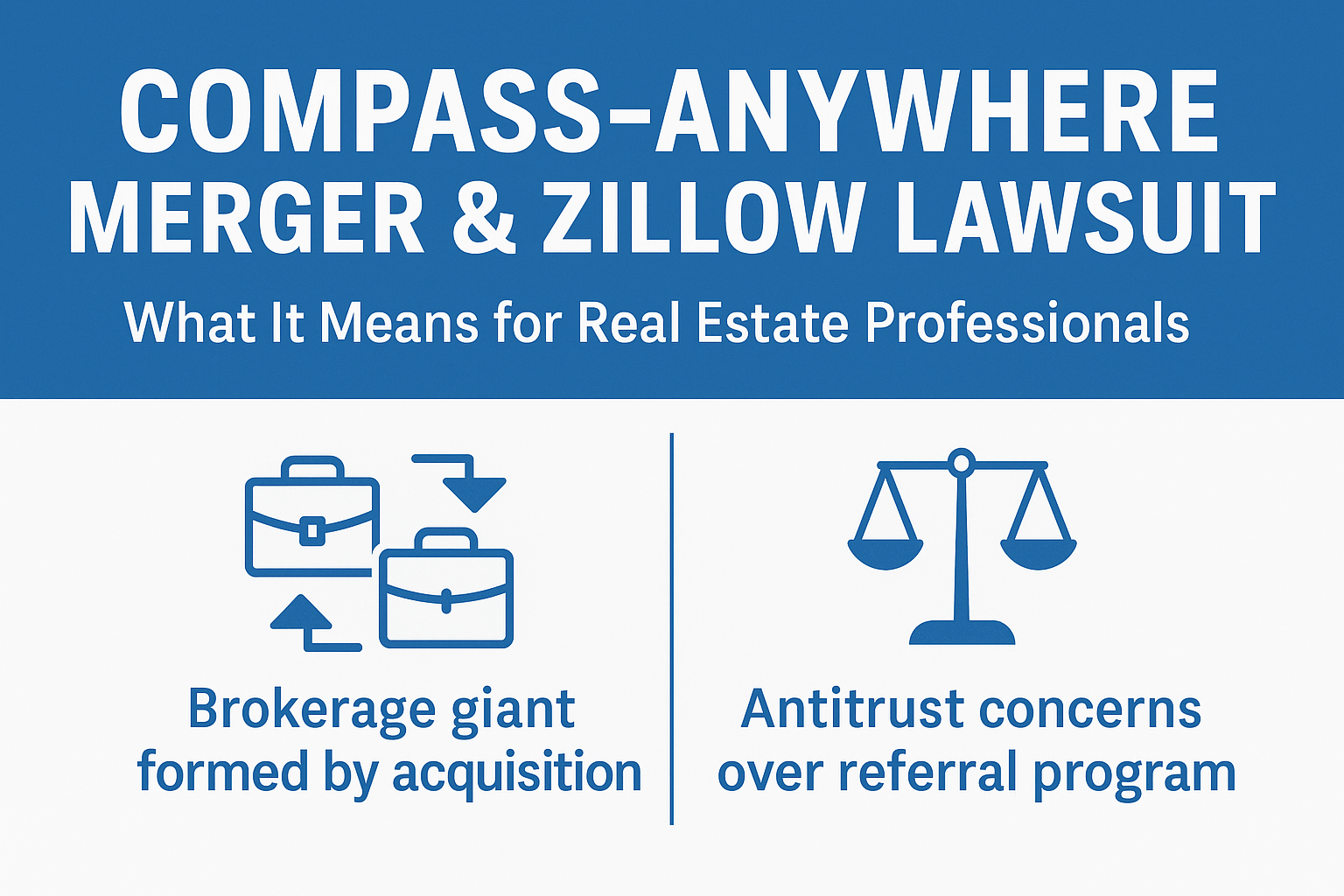
    • Compass announced plans to acquire Anywhere Real Estate, combining massive franchises like Coldwell Banker, Century 21, Corcoran, Sotheby’s, and others to form what the companies say would become the world’s largest residential brokerage. (realestatenews.com)
    • Law firms behind the Moehrl commission lawsuits have named Zillow as a new defendant in a class-action suit, alleging its “Flex” referral program and listing policies deceive buyers and inflate costs. (realestatenews.com)

    At first glance, they might seem like separate stories — one about consolidation, the other about legal exposure. But together, they sketch a blueprint of future pressures and opportunities for real estate professionals. Below, we draw parallels, unpack what each development may signify, and suggest practical takeaways for agents, teams, and brokerages.

    What Each Story Means for Real Estate Professionals

    1. Compass + Anywhere: The Rise of a Brokerage Giant

    What’s happening?

    • Compass will absorb Anywhere Real Estate (Coldwell Banker, Century 21, Corcoran, Sotheby’s, and more) in an all-stock deal valued at $10B.
    • The combined firm would represent ~340,000 agents in ~120 countries.
    • Integration promises stronger tech, marketing, and backend systems — but also potential standardization of fees and lead routing.
    • Industry questions remain about off-MLS listings and transparency of deal flow.

    What it might mean for agents and brokerages:

    • Brand pressure: Independents may face more competition from mega-broker tools and marketing reach.
    • Commission & fees: Expect possible standardization across brands. Read the fine print carefully.
    • Lead control: Referrals and inbound leads could be centralized — know where yours are going.
    • Listing visibility: Watch for shifts toward private exclusives. Ask about listing exposure upfront.
    • Tech access: Big benefits in systems and marketing tools, but don’t lose ownership of your client data.

    2. Moehrl Law Firms Target Zillow

    What’s happening?

    • New class action alleges Zillow’s Flex program misleads buyers by concealing referral fees up to 40% of agent commissions.
    • The lawsuit also challenges Zillow’s “listing access standards,” which may coerce agents into mandatory syndication.
    • Zillow, with 66% online real estate audience share, is accused of abusing dominance to inflate costs.

    What it might mean for agents and brokerages:

    • Referral transparency: Courts may force disclosure of platform cuts. Be upfront with clients about fees.
    • Lead dependency: If Zillow’s model changes, agents reliant on Flex could lose a pipeline. Diversify now.
    • Listing syndication: Rules may shift. Don’t assume Zillow exposure is mandatory.
    • Legal/reputation risk: Agents tied to portal programs could face reputational fallout.

    Big Picture: What This Dual Pressure Tells Us

    1. Scale + control = influence. The middlemen — broker giants and portals — increasingly shape transaction terms.
    2. Transparency is a battleground. Hidden referral fees and off-market listings are under scrutiny.
    3. Diversify your leads. Don’t depend on a single portal or brokerage funnel.
    4. Legal risk is rising. Middlemen models face more antitrust and consumer protection challenges.
    5. Agility matters. Smaller brokerages can exploit gaps created by scale integration challenges.

    Action Steps

    • Audit referral/lead contracts for hidden fees.
    • Diversify your lead sources beyond portals.
    • Negotiate data ownership in brokerage/tech agreements.
    • Stay engaged with legal and policy updates via your association.
    • Highlight transparency in your client messaging.
    • Be nimble — leverage your independence when giants stumble.

    Conclusion

    The Compass-Anywhere megamerger and the lawsuit against Zillow are two sides of the same coin: consolidation of power and growing scrutiny of those who hold it. For real estate professionals, the path forward is clear — lean into transparency, protect your independence, and diversify your business pipelines. The industry’s balance of power is shifting, but those who adapt quickly will thrive.

  • Charlie Kirk Comments Cost Las Vegas REALTOR® Leadership Role — What the Industry Can Learn

    Charlie Kirk Comments Cost Las Vegas REALTOR® Leadership Role — What the Industry Can Learn

    The recent removal of an incoming Las Vegas REALTORS (LVR) board director offers a timely reminder for every real estate professional: what we say online matters, and leadership comes with higher expectations.

    What Happened

    Mark Sivek, a broker with Realty One Group, was slated to join the Las Vegas REALTORS (LVR) Board of Directors. That changed after he posted inflammatory comments on LinkedIn in response to the assassination of conservative activist Charlie Kirk.

    What he said: On LinkedIn, in response to a sympathetic comment about Kirk’s murder, Sivek wrote:

    “He was a despicable human being. Promoted hate and violence. A real pos!! Live by the sword die by the sword. F** Charlie Kirk! The world is a better place without him. Shame on you for supporting this disgusting moron.”* — Weekly Real Estate News

    The remarks circulated quickly, sparking widespread criticism. LVR leadership moved swiftly, announcing he would not be seated on the board and emphasizing that “we do not condone hateful or potentially hurtful speech, and such comments do not reflect the views and values of our association and profession.”

    The fallout continued: LVR President George Kypreos confirmed Sivek was removed from his incoming director role and other appointed positions. Sivek later issued an apology, writing: “Yesterday I posted a very incendiary comment about the assassination of Charlie Kirk. I humbly seek forgiveness for all whom I offended.” Soon after, his social media was deactivated, and he resigned from additional board roles slated for 2026 and 2027.

    Why It Matters

    This case underscores three important truths for those of us in real estate:

    1. Professionalism doesn’t clock out.
      As REALTORS®, our Code of Ethics applies not only in transactions but in our broader conduct. Leadership especially magnifies the impact of our words, online or offline.

    2. Free speech has professional consequences.
      While everyone is free to speak their mind, trade associations have clear codes of conduct. Hateful or celebratory speech around violence, even expressed personally, can be grounds for removal from leadership roles.

    3. Reputation is fragile.
      Years of service and experience can be overshadowed by one misjudged post. For clients, colleagues, and the public, our digital footprint reflects directly on our trustworthiness.

    The Bigger Picture

    NAR’s Code of Ethics prohibits harassing or hate speech in real estate-related activities. LVR’s own social media policy also warns that defamatory or hurtful content may lead to discipline or removal from leadership. In this case, both frameworks were clear, and the association acted swiftly to uphold them.

    Takeaway for Real Estate Professionals

    The lesson here isn’t just about one individual—it’s about all of us. Real estate is built on credibility and trust. Whether you’re an agent, broker, or aspiring leader, the way you communicate shapes your reputation and, by extension, your business.

    • Think before you post.

    • Assume clients, colleagues, and competitors may see what you write.

    • Ask: Does this reflect the professionalism I want to be known for?

    A Gentle Warning—and Encouragement

    We all face moments of strong emotion, and social media makes it easy to react instantly. But our role as professionals calls us to pause, reflect, and lead by example. The same discipline that drives us to negotiate with integrity and serve clients faithfully should extend to our digital voices.

    Leadership in real estate isn’t just about market knowledge—it’s about embodying the standards of our profession, even in the most heated moments.


    👉 Bottom line: Guard your professionalism as carefully as you guard your license. A single post can cost opportunities, but steady integrity will always build the trust that keeps your business thriving.


    See what others are saying…
    Join the conversation on Facebook.

    Sources